
What Members Expect from Digital Banking in 2026
The bar for digital banking has never been higher. Members who once celebrated the ability to check their balance on a phone now expect their credit union to anticipate their needs, resolve issues instantly, and deliver an experience that rivals the best consumer apps on the market.
For credit unions, this is both a challenge and an opportunity. You have something the big banks don't — a genuine relationship with your members. The question is whether your technology lets that relationship shine through.
Speed Is No Longer a Differentiator — It's the Minimum
A few years ago, a fast mobile app was a competitive advantage. Today, it's table stakes. Members expect transactions to process in real time, loan decisions to arrive in minutes, and support to be available around the clock.
Research consistently shows that slow digital experiences are the number one reason members consider switching financial institutions. A 30-second wait for a balance to refresh or a multi-day hold on a mobile deposit isn't just inconvenient — it signals to your member that you're behind the times.
What this means for credit unions: Core processing speed, real-time payment rails, and instant notification systems are no longer optional upgrades. They're foundational requirements for member retention.Personalization Has Moved from Nice-to-Have to Expected
Members don't want to feel like account numbers. They want their credit union to know them — their financial goals, their life stage, their preferences.
The rise of AI-driven personalization in consumer apps has reset expectations across every industry. When a streaming service knows what you want to watch before you do, members start asking why their credit union can't proactively suggest a better savings rate or flag an unusual charge before they notice it themselves.
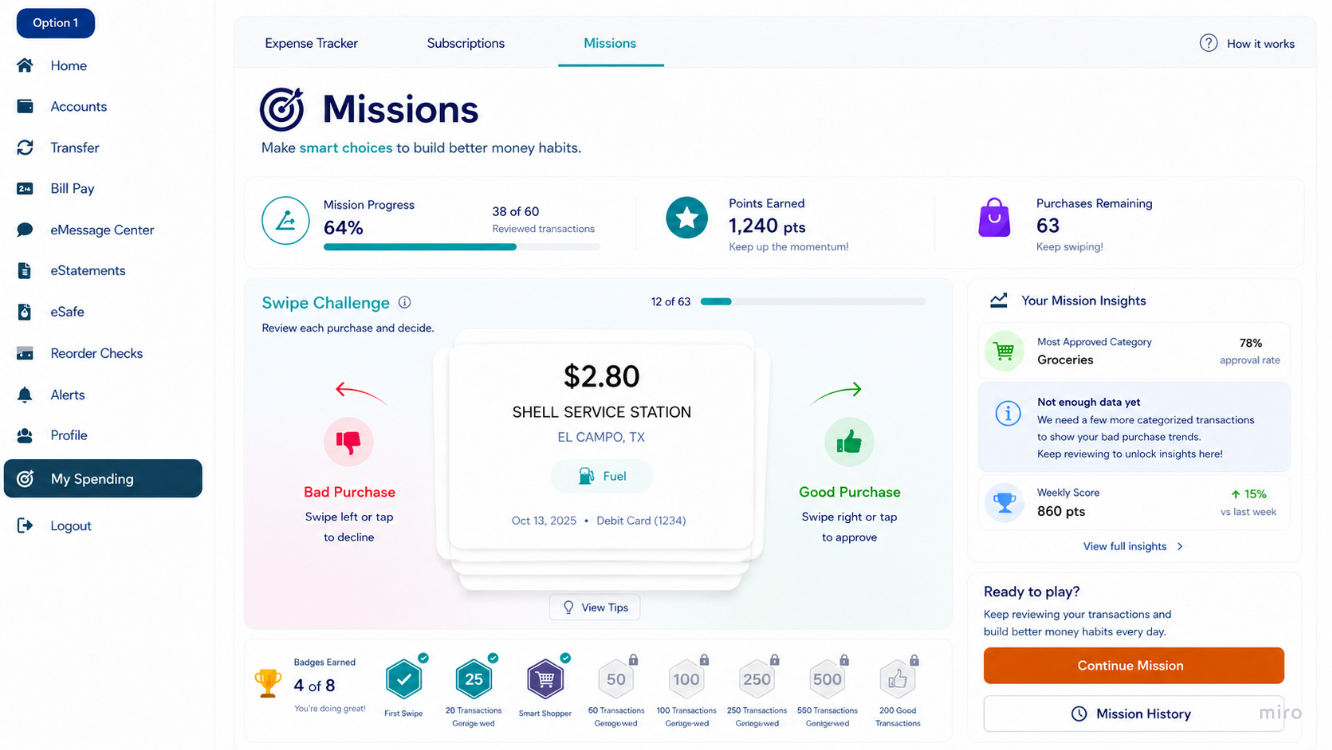
!Milly Missions dashboard showing gamified savings challenges, points, and spending insights
Personalization in digital banking looks like:
- Proactive alerts tailored to spending patterns
- Product recommendations based on life events (home purchase, new baby, retirement planning)
- Customized dashboards that surface what matters most to each member
- Communication in the channel and at the time each member prefers
Credit unions that invest in data-driven personalization see measurably higher engagement, lower churn, and stronger cross-sell performance.
Seamless Omnichannel Experience Is Non-Negotiable
Members move fluidly between channels — they start a loan application on mobile, continue it on desktop, and finish it in a branch. They expect the experience to be continuous, not fragmented.
Nothing erodes trust faster than a member having to repeat themselves. If someone called your contact center yesterday about a dispute, they shouldn't have to re-explain the situation when they follow up via chat today.
A true omnichannel experience requires:
- Unified member data accessible across every touchpoint
- Consistent branding and UX across mobile, web, and in-branch
- Context-aware service that picks up where the last interaction left off
- Integrated back-office systems that eliminate data silos
Self-Service Is the Preferred Default
Today's members — especially those under 45 — strongly prefer to resolve issues themselves before contacting support. They want robust self-service tools that let them manage their accounts without picking up the phone.
This includes:
- Instant card controls (freeze, unfreeze, set spending limits)
- Self-service dispute initiation
- Real-time loan payoff quotes and refinance calculators
- Automated account opening and onboarding
- Digital document signing and upload
When self-service fails or a situation genuinely requires human help, the transition to a live agent should be effortless — with full context carried over so the member never has to start from scratch.
Security That Doesn't Create Friction
Members want to feel safe. But they also don't want to jump through hoops every time they log in. The expectation in 2026 is intelligent security — systems that recognize normal behavior and step up authentication only when something looks unusual.
Biometric login, behavioral analytics, and risk-based authentication have become the standard. Multi-factor authentication is expected, but it should be streamlined — a push notification or fingerprint scan, not a six-step verification process for a routine balance check.
Credit unions that get security right protect members without making them feel like suspects.
What This Means for Your Technology Stack
Meeting these expectations isn't about adding features one at a time. It requires a connected technology ecosystem where your core, digital banking platform, back office, and member-facing tools share data and work together seamlessly.
Credit unions that are winning in this environment have made deliberate investments in:
- Modern core processing that supports real-time data and open APIs
- Digital banking platforms built for personalization at scale
- Back-office automation that reduces manual work and speeds up service
- Investment and financial wellness tools that deepen member relationships
The good news: you don't have to build this from scratch. The right technology partners can help you close the gap quickly — and give your members the experience they're already expecting.
The Credit Union Advantage
Here's what the big banks can't replicate: your members actually trust you. They joined a credit union because they wanted a financial institution that puts people first. Your technology should make that promise tangible at every touchpoint.
When your digital experience matches your cooperative values — transparent, member-first, built for real people — you don't just retain members. You turn them into advocates.
The question isn't whether to invest in better digital banking technology. It's how quickly you can get there.